Travel Expense Tracker Log Book
Keeping track of travel-related costs doesn’t have to mean juggling spreadsheets, sticky notes, or fragmented receipts. A well-designed Travel Expense Tracker Log Book offers a simple, tactile, and highly effective way to capture every dollar spent on the road—whether you're a freelancer attending client meetings, a small business owner managing team travel, or a digital creator documenting deductible expenses for tax season.
What Is a Travel Expense Tracker Log Book?
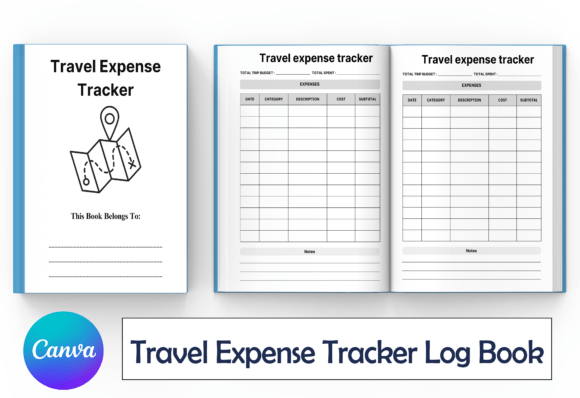
At its core, the Travel Expense Tracker Log Book is a structured, ready-to-use journal that guides users through consistent, chronological logging of transportation, lodging, meals, incidentals, mileage, and more. Unlike generic notebooks, it features pre-formatted fields—date, purpose, location, category, amount, payment method, and notes—designed to support clarity, accountability, and IRS-compliant recordkeeping.
This particular version is optimized for creators entering the Kindle Direct Publishing (KDP) low-content or no-content space. It’s not just a functional tool—it’s a scalable product asset: professionally formatted, print-ready, and fully customizable via included Illustrator EPS files.
Why This Design Stands Out
Many expense logs sacrifice usability for aesthetics—or vice versa. This Travel Expense Tracker Log Book balances both:
- Consistent page layout: Each entry spans one page (or two facing pages), reducing cognitive load and encouraging daily use.
- Smart spacing: Ample room for handwritten notes, receipt stickers, or quick annotations—no cramped lines or overwhelming grids.
- Scalable structure: Available in three interior lengths—100, 110, or 120 pages—so you can match volume to audience needs (e.g., shorter versions for short-term trips; longer ones for annual business travelers).
- Print-optimized specs: 8.5 x 11 inches interior size, no bleed, CMYK-ready PDF—ideal for KDP upload with zero formatting surprises.
Designed for Creators—and Users
For KDP sellers, this isn’t just another log book—it’s a versatile foundation. The included Illustrator EPS file gives full creative control: change fonts, adjust column widths, add branding, insert custom headers, or localize currency symbols. You’re not locked into someone else’s template—you own the design process.
For end users—whether they purchase it as a physical journal or download a printable PDF—the value lies in immediacy and reliability. No software setup. No learning curve. Just open, write, and go.
Who Benefits Most From This Tool?
The Travel Expense Tracker Log Book serves diverse needs across professional and personal contexts. Here’s where it adds real-world value:
- Self-employed professionals: Consultants, photographers, coaches, and contractors often deduct travel as a business expense. A clean, organized log simplifies year-end reconciliation and strengthens audit readiness.
- Remote workers & hybrid teams: With increasing “work-from-anywhere” policies, tracking client visits, co-working fees, or transit passes becomes essential—not optional.
- Small business owners: Managers who reimburse staff for travel need verifiable, standardized records. A uniform log book encourages consistency across the team.
- Frequent travelers: Whether for conferences, family visits, or relocation prep, having a dedicated place to log costs helps spot spending patterns and plan future budgets.
- Students & interns: Those completing fieldwork, study-abroad programs, or unpaid internships may still incur travel costs—and sometimes qualify for stipends or reimbursements.
Real Scenarios Where It Makes a Difference
Consider these everyday examples:
- A freelance graphic designer drives 45 miles to meet a client in another city. She logs the date, destination, round-trip mileage (using the built-in mileage calculator section), parking fee, and lunch expense—all in one place. Come tax time, she exports totals by category without flipping through email threads or photo folders.
- An HVAC contractor sends three technicians on separate service calls across two counties. Each receives a copy of the Travel Expense Tracker Log Book. Their consistent entries make weekly reimbursement processing faster—and reduce disputes over missing details.
- A nonprofit program coordinator travels to rural communities for outreach events. Her organization requires itemized reports for grant compliance. Instead of compiling spreadsheets post-trip, she fills out her log book en route—and submits clean, legible summaries within 48 hours.
Strengths—and Honest Considerations
Like any tool, the Travel Expense Tracker Log Book excels when matched to the right use case—but it’s important to understand its scope:
Key strengths:
- Accessibility: Works offline, requires no subscription, and supports handwriting—a plus for those avoiding screen fatigue or digital overload.
- Privacy: Physical or locally printed logs keep sensitive financial data off cloud platforms or third-party apps.
- Customization flexibility: The EPS source file empowers designers to adapt colors, layouts, and language—ideal for niche markets like medical travelers, educators, or faith-based missions.
- KDP-friendly production: No bleed, standard trim size, and PDF export mean fewer upload rejections and faster time-to-market.
Practical considerations:
- This is a log book, not accounting software. It won’t auto-calculate taxes, sync with bank feeds, or generate invoices. Its power lies in disciplined manual input—not automation.
- Handwritten entries require legibility and consistency. For users who prefer voice-to-text or mobile scanning, pairing the log book with a companion app (like Expensify or QuickBooks Self-Employed) can bridge gaps—but isn’t required.
- While the 8.5 x 11 format offers generous writing space, it’s less portable than pocket-sized alternatives. Users prioritizing on-the-go convenience may prefer supplementing with a compact version for day trips.
Evaluating Fit for Your Needs
Ask yourself these questions before choosing—or creating—a Travel Expense Tracker Log Book:
- Do you need a physical, analog system that works without Wi-Fi, batteries, or updates?
- Are your travel expenses recurring enough to justify a dedicated, reusable system—not just a one-off spreadsheet?
- Will others (team members, accountants, auditors) need to read or verify your logs? If so, clarity and consistency matter more than decorative flair.
- If you’re designing for KDP: Does your target audience prefer minimalism or visual guidance (e.g., icons, color-coded sections)? The EPS file lets you test both.
- Is your goal compliance-readiness, spending awareness, or reimbursement efficiency? Each emphasis shapes how you’ll use—and promote—the log book.
Final Thoughts: Simplicity With Substance
In an age of ever-more-complex productivity tools, there’s enduring value in thoughtful simplicity. The Travel Expense Tracker Log Book doesn’t try to do everything. It does one thing exceptionally well: help people capture, organize, and reflect on travel spending—without friction.
For creators, it’s a low-risk, high-potential KDP asset—ready to personalize, brand, and scale. For users, it’s peace of mind in paper form: a quiet, reliable companion for every mile traveled and every dollar spent.
Whether you’re planning your first self-published journal or looking for a smarter way to manage business travel, this Travel Expense Tracker Log Book proves that sometimes, the most powerful tools are the ones you can hold in your hand—and fill at your own pace.