Blank Comic Book Template
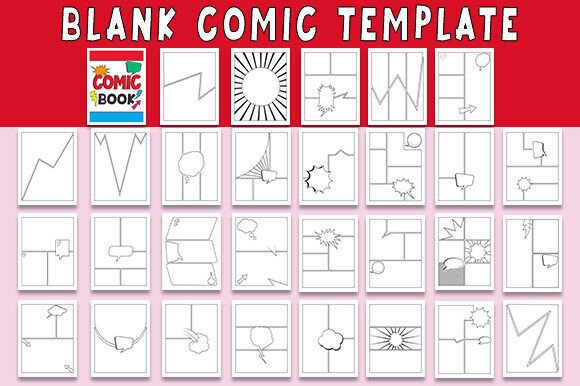
A Blank Comic Book Template is more than lined panels and empty speech bubbles—it’s a structured creative scaffold designed for clarity, intention, and execution. Unlike generic drawing pads or unformatted digital canvases, this template delivers 30 professionally laid-out pages in CMYK color, 300 DPI resolution, with native AI, PDF, SVG, and high-resolution JPEG files. That means it’s production-ready: whether you’re sketching storyboards for a client pitch, prototyping a branded comic series, or developing visual learning tools for your team, the Blank Comic Book Template removes friction between idea and output.
Why Structure Matters More Than Blank Space
Most people assume creativity thrives in total freedom—unbounded paper, infinite layers, no rules. In practice, that often leads to hesitation, inconsistent pacing, or abandoned projects. A well-designed Blank Comic Book Template counters that by embedding strategic constraints: panel count per page, gutter spacing calibrated for print legibility, bleed-safe margins, and typography-friendly caption zones. These aren’t limitations—they’re decision accelerators. When you know where the gutters fall and how many panels fit cleanly on a spread, you spend less time troubleshooting layout and more time refining narrative flow, character motivation, or visual metaphor.
For educators building custom literacy materials, that consistency supports cognitive load management—students focus on content, not deciphering irregular layouts. For marketers launching a product via sequential storytelling, it ensures visual rhythm aligns with message hierarchy. For freelancers pitching visual concepts to non-design stakeholders, the template provides immediate credibility: it signals preparation, professionalism, and attention to deliverable standards—not just artistic intent.
Strategic Use Cases Beyond “Just Drawing”
The value of the Blank Comic Book Template multiplies when applied deliberately across domains:
- Internal process mapping: Translate complex workflows—customer onboarding, software deployment, compliance training—into step-by-step visual narratives. Panels become stages; captions become decision points. Teams grasp interdependencies faster than in bullet-point documents.
- Brand voice development: Use the template to storyboard tone, persona, and emotional cadence across touchpoints. What does “friendly but authoritative” look like in three panels? How does “urgent but trustworthy” shift across a six-panel sequence? This surfaces inconsistencies before launch.
- Client-facing concept testing: Instead of abstract mood boards or wireframes, present early-stage ideas as low-fidelity comic sequences. Clients respond more concretely to narrative context than isolated visuals—and feedback becomes actionable (“Move the call-to-action to panel 4” vs. “Make it pop more”).
- Learning retention design: Research shows sequential art improves recall by up to 40% for procedural knowledge. Educators and L&D professionals use the Blank Comic Book Template to convert SOPs, safety protocols, or soft-skill frameworks into memorable visual scripts—without needing illustration skills.
When to Reach for the Template (and When Not To)
Reach for the Blank Comic Book Template when your goal requires sequencing, pacing, or audience guidance. It shines when you need to:
- Clarify cause-and-effect relationships (e.g., “What happens if the user skips step two?”);
- Surface assumptions in stakeholder conversations (“Let’s draw what ‘fast onboarding’ looks like to each of us”);
- Bridge gaps between technical and non-technical teams (“Show me the customer journey—not the API flow”);
- Pre-test messaging resonance before committing to full production.
Avoid defaulting to it when speed is the sole priority (a whiteboard sketch may suffice), when fidelity requirements demand bespoke illustration (this is a scaffold—not a finished asset), or when your audience has no visual literacy baseline (e.g., regulatory submissions requiring strict textual documentation). The Blank Comic Book Template is a tool for amplifying intent—not substituting for strategy.
How to Use It Intentionally—Not Just Automatically
Start with outcome-first framing: What decision should this comic enable? Who needs to understand what, by when? If the answer is vague (“to be creative” or “to make something cool”), pause. Reframe the objective. Examples:
- “Help our sales team visualize common objection-handling scenarios so they can practice responses in context.” → Use 3-panel sequences: problem → misstep → resolution.
- “Align engineering and marketing on the user’s emotional journey during feature rollout.” → Assign one page per phase (awareness → trial → adoption), using consistent character design to represent the user.
- “Explain GDPR consent mechanics to non-legal staff.” → Replace jargon with visual metaphors (e.g., a lock icon unlocking only when all three checkboxes are selected).
Then, leverage the file formats intentionally: use AI files for precise vector edits (logo placement, font pairing), SVG for web embedding with responsive scaling, PDF for client review with embedded fonts and print-safe colors, and JPEG for quick social previews. Don’t treat all formats as interchangeable—each serves a distinct operational need.
Risks of Using the Template Without Context
A Blank Comic Book Template used without clear goals risks becoming decorative noise. Common pitfalls include:
- Over-formatting at the expense of substance: Spending hours adjusting panel borders while neglecting narrative logic or audience relevance;
- Assuming visual = universal: Using culturally specific gestures, symbols, or color associations without testing with target users;
- Underestimating production handoffs: Designing in RGB then discovering print requires CMYK conversion—and that vibrant screen blue turns muddy on coated stock;
- Mistaking completion for impact: Filling all 30 pages without defining success metrics (e.g., “Will this reduce support tickets about X?” or “Will learners pass the scenario-based quiz at >85%?”).
These aren’t flaws in the template—they’re symptoms of applying structure without strategy. The Blank Comic Book Template magnifies intention. It won’t compensate for unclear objectives, weak research, or untested assumptions.
Long-Term Value: Building Repeatable Visual Systems
The highest ROI from the Blank Comic Book Template emerges over time—not per project, but across them. As you use it repeatedly, patterns emerge: recurring character archetypes that represent your audience segments, standardized panel ratios for different content types (e.g., 4-panel grids for troubleshooting, full-page illustrations for key messages), consistent color coding for emotional states or priority levels. These evolve into an internal visual language—one that reduces onboarding time for new team members, increases cross-functional alignment, and strengthens brand coherence across mediums.
That system doesn’t happen by accident. It requires documenting choices: why panel 3 always contains the pivot moment, why green accents signal verified information, why speech bubbles use rounded corners for empathy-driven contexts. Treat the Blank Comic Book Template as the first node in your organization’s visual grammar—not as a one-off artifact.
Final Strategic Note
A Blank Comic Book Template is not about drawing ability. It’s about decision discipline. Every panel you place, every caption you write, every color you select reflects a choice about emphasis, sequence, and audience. Used thoughtfully, it transforms ambiguity into action, complexity into clarity, and ideas into shared understanding. But it only delivers that value when anchored to purpose—not just possibility.