Daily Planner 2025 – 1 Page Per Day
If you’ve ever stared at a blank calendar page wondering how to actually *use* it—not just fill it in, but build momentum, reduce decision fatigue, and show up more consistently for your goals—then the Daily Planner 2025 – 1 Page Per Day might be the quiet upgrade your routine needs. It’s not flashy. It doesn’t promise overnight transformation. But it does something quietly powerful: it gives every day its own dedicated space—no scrolling, no tabs, no app notifications—to reflect, plan, and anchor yourself in what matters *today*.
What It Really Is (Beyond the Specs)
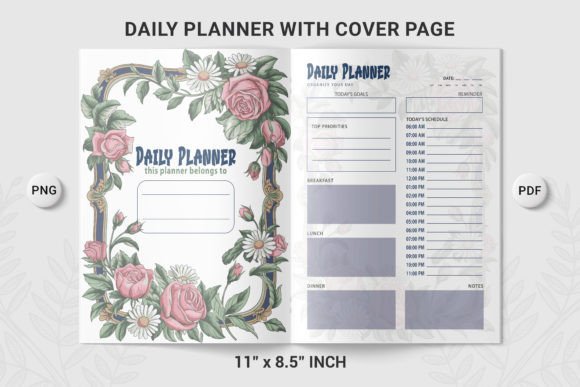
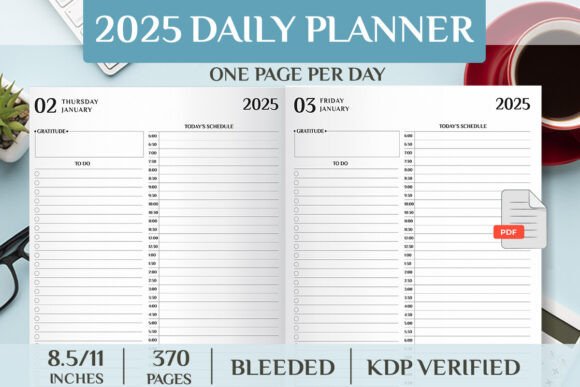
This isn’t just another printable PDF. The Daily Planner 2025 – 1 Page Per Day is a thoughtfully structured, black-and-white, 370-page interior file designed specifically for Amazon KDP—8.5″ x 11″, fully bleeded, ready to upload and print. That means clean edges on every page, no awkward white borders cutting into your layout, and consistent formatting whether you’re printing locally or ordering through KDP’s print-on-demand service.
Each day gets one full page—no cramming, no flipping back and forth. You’ll find room for a date header, space to jot down top priorities, quick notes, gratitude or reflection prompts, habit tracking, and even a small section for tomorrow’s “one thing” to carry forward. It’s minimal by design—not stripped down to the point of emptiness, but intentionally spacious enough to invite clarity instead of clutter.
Where This Planner Fits Into Real Life (Not Just Ideal Life)
Think about your Tuesday at 4:17 p.m.: You’ve just wrapped a Zoom call, your to-do list has three items crossed off and five new ones added, and your brain feels like a browser with 14 tabs open. That’s when a single, uncluttered page—no digital distractions, no sync errors, no battery anxiety—becomes your reset button.
- Freelancers & solopreneurs use it to block time for deep work *before* client emails flood in—and then track which projects actually moved the needle that day, not just which ones got replies.
- Teachers and school counselors keep one copy on their desk for daily classroom reflections (“What landed well today? What felt rushed?”) and another in their bag for parent meeting notes—no risk of mixing personal and professional entries.
- Healthcare workers appreciate the physical separation between shift notes (what went smoothly, what tripped them up) and personal intentions—especially after emotionally heavy days where mental boundaries matter deeply.
- Students juggling part-time jobs and coursework use the “one thing for tomorrow” prompt to avoid waking up overwhelmed—just one clear next step written the night before helps lower the activation energy to start.
- Caregivers often repurpose the margin space for quick medication logs, appointment follow-ups, or even voice-to-text notes later transcribed—because flexibility matters when your schedule shifts hourly.
Why the Format Makes a Difference
The 8.5″ x 11″ size isn’t arbitrary. It’s large enough to write comfortably without squinting, yet compact enough to fit in most tote bags or laptop sleeves. And because it’s fully bleeded, the printed version feels intentional—not like a document slapped onto paper, but like a designed tool you chose.
That “1 page per day” structure also changes how your brain engages with time. Digital calendars highlight *when*. This planner emphasizes *how*—how did I spend my attention? How did I respond to stress? How did small choices add up? One teacher told us she started noticing patterns only after week three: her “energy dips” always aligned with back-to-back parent meetings, not late nights—so she began scheduling lighter tasks afterward. That insight didn’t come from analytics—it came from having the same visual rhythm, day after day.
Who Might Want to Pause and Consider Alternatives
This planner shines when you value consistency over customization—but it’s worth acknowledging where it may not be the best fit.
- If you need weekly overviews *alongside* daily pages (e.g., seeing your whole week at a glance while planning each day), this format won’t give you that built-in layer. You’d pair it with a separate weekly tracker—or use it alongside a simple wall calendar.
- If color-coding is non-negotiable for your workflow (e.g., red for deadlines, green for wellness), the black-and-white interior means you’ll rely on pens, highlighters, or symbols—not pre-printed cues. That’s a strength for some (fewer visual distractions), a limitation for others.
- If your planning happens almost entirely on mobile—capturing ideas in transit, syncing across devices—the physical nature means it’s a deliberate choice, not a passive habit. It won’t replace your phone’s reminders—but it *can* replace the mental load of trying to remember what those reminders were for.
Practical Things to Know Before You Use It
You’ll get one clean PDF—no layers, no editable text boxes, no fonts to install. That simplicity is intentional: it prints reliably on any home or commercial printer, and KDP accepts it without formatting hiccups. There’s no “setup” phase—you open to January 1st and begin.
A few subtle but helpful details:
- The 370-page count includes title, copyright, and year-at-a-glance pages—so all 365 days are accounted for, plus breathing room for notes or a quick index you create yourself.
- Because it’s designed for bleed, if you’re printing at home, set your printer to “borderless” or “full-bleed” mode if available—or trim lightly after printing for that polished look.
- It’s optimized for black ink only, so it’s economical to print—even if you go through multiple copies in a year.
- No dated headers mean it’s reusable beyond 2025 if you prefer undated planning—just flip to a fresh page and write in the date manually.
How People Actually Adapt It Over Time
One graphic designer uses the bottom quarter of each page as a “visual scratchpad”—sketching logo concepts, wireframing app flows, or doodling color palettes. Another user, managing remote team standups, writes her “three wins from yesterday” there—not for accountability, but to train her brain to spot progress, not just problems.
A retired nurse repurposed the gratitude line into “one thing my body let me do today”—shifting focus from loss to capability during recovery. A high school math teacher uses the “tomorrow’s one thing” space to write a single question she’ll ask her students the next day—something open-ended, not answerable in one word—to spark discussion before class even begins.
None of these uses were in the original description. They emerged because the structure was stable enough to trust, but open enough to grow into.
When Simplicity Isn’t Minimalism—It’s Strategy
The Daily Planner 2025 – 1 Page Per Day doesn’t try to solve everything. It doesn’t include budget trackers, meal planners, or fitness logs. Instead, it creates a neutral, repeatable container where *your* priorities—not someone else’s template—get center stage. That’s why people return to it year after year: not because it’s perfect, but because it’s dependable. Because it asks little of you at first glance—and gives back more than you expect when used, not just owned.