2025 Mental Health Self-Care Planner
This isn’t just another calendar with checkboxes. The 2025 Mental Health Self-Care Planner is a thoughtfully structured, visually grounded tool built for people who know self-care isn’t indulgence—it’s infrastructure. Designed with quiet confidence and warm intentionality, its aesthetic balances clean minimalism with gentle human texture: soft margins, ample white space, subtle line weights, and a layout rhythm that breathes with you—not against you. It doesn’t shout. It listens. And it holds space—literally and emotionally—for reflection, consistency, and growth.
Visually, the planner leans into modern typography without sacrificing warmth. Headings use a friendly, slightly rounded sans serif—clear at 8.5 × 11 inches, legible when printed at 300 DPI, and perfectly balanced in CMYK for professional KDP output. Body text is optimized for long-form journaling: generous x-height, open counters, and consistent letter spacing so your mood notes, gratitude entries, or medication logs feel effortless to write—and easy to revisit months later. There’s no visual noise, no competing decorative elements. Just clarity, purpose, and calm authority.
Where This Planner Earns Its Place—Beyond the Page
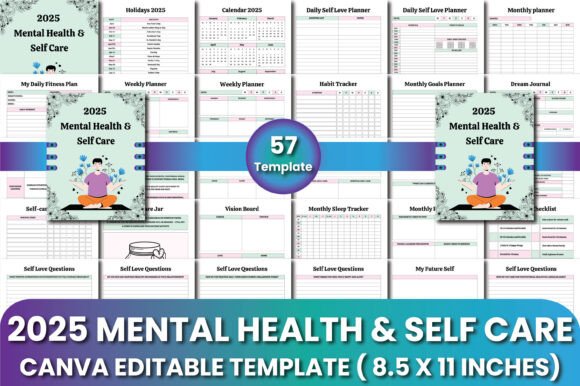
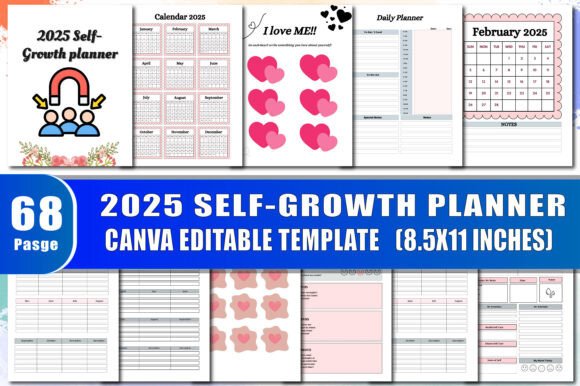
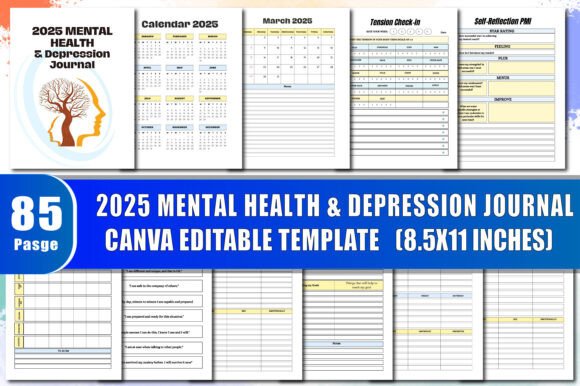
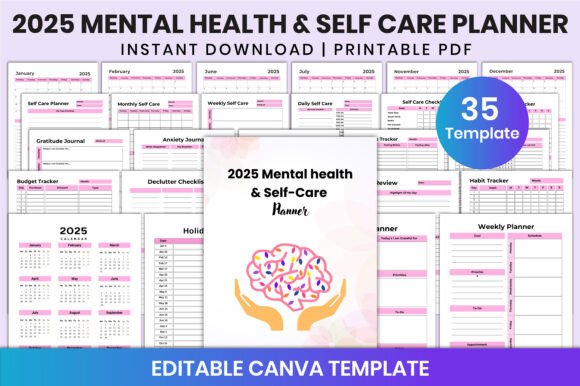
The 2025 Mental Health Self-Care Planner works hardest where intention meets action—across digital, print, and personal contexts. For designers and publishers building mental wellness brands, it’s a ready-made design system: the 35 editable Canva templates include consistent typographic hierarchy, smart grid alignment, and intentional whitespace distribution—ideal for adapting into branded workbooks, client onboarding kits, or therapist resource bundles. Entrepreneurs launching coaching programs use the editable interior files to customize affirmations, embed their logo, or add signature frameworks—without touching code or hiring a designer.
Bloggers and content creators repurpose daily tracker layouts into Instagram carousels or Pinterest pins. The weekly self-care spread? A natural fit for email newsletter templates. The monthly reflection prompts? Perfectly suited for lead magnets that convert because they *feel* useful—not salesy. Even hobbyists and crafters appreciate how the declutter checklist or habit tracker translates seamlessly into printable wall art or bullet journal inserts—no resizing, no pixelation, no guesswork.
Readability Isn’t Optional—It’s Foundational
Mental health tools fail when they fatigue the user. That’s why every element of the 2025 Mental Health Self-Care Planner supports cognitive ease. Line height is tuned for sustained reading—not just scanning. Font size scales meaningfully between headers (for quick orientation) and journal lines (for comfortable handwriting). The mood tracker uses intuitive color-coding and simple iconography—not dense grids or ambiguous scales. Even the budget tracker avoids financial jargon, favoring plain-language categories and clear input zones.
This attention to readability directly shapes brand perception. When your audience opens this planner and immediately understands where to log today’s anxiety level or plan tomorrow’s walk, they register your offering as trustworthy, empathetic, and professionally considered. Consistency across January–December spreads builds recognition—subtly reinforcing reliability. And because all files are delivered in CMYK with no bleed, what prints from a home inkjet matches what ships from KDP—no surprises, no rework, no erosion of credibility.
Editing With Purpose—Not Just Pixels
The included editable Canva link isn’t a gimmick. It’s a workflow accelerator. You’re not just changing colors—you’re adapting tone. Swap a soft sage header for deep navy to signal clinical rigor; lighten the background tint for accessibility; adjust column widths to accommodate longer reflections. Each of the 35 templates serves a distinct function: the daily review page prioritizes brevity and closure; the gratitude journal spreads encourage expansion and warmth; the medication tracker uses bold, high-contrast labels for quick visual anchoring.
Before finalizing any customization, test two things: first, print a sample page at actual size—does the handwritten “Notes” section leave room for your natural script? Second, open the PDF on a tablet—does the weekly planner scroll smoothly? Does tapping the mood tracker icon feel responsive? These aren’t technicalities—they’re experience touchpoints that determine whether someone reaches for the planner again next week.
Licensing That Lets You Build—Without Limits
This is a commercial-use planner—full stop. Whether you’re bundling it into a paid wellness course, selling printed copies via Etsy, or including it as a bonus in a KDP workbook, the license covers it. No hidden restrictions. No need to credit the original creator unless you choose to. That freedom matters when you’re scaling: you can confidently build product ecosystems around the 2025 Mental Health Self-Care Planner—adding companion audio guides, printable sticker sheets, or video walkthroughs—knowing your foundation is legally sound and creatively flexible.
Still, thoughtful usage beats blanket reuse. If you’re designing for neurodivergent users, consider enlarging the daily planner font in Canva before exporting. If your audience includes older adults, test contrast ratios on the gratitude journal lines. Small adjustments like these don’t require design expertise—they require observation, empathy, and respect for how real people engage with tools in real life.
At its core, the 2025 Mental Health Self-Care Planner succeeds because it refuses to treat mental wellness as abstract. It’s tactile. It’s structured but not rigid. It’s professional without being cold. And whether you’re using it solo at 6 a.m. with coffee, adapting it for a corporate wellness initiative, or integrating it into a creative business launch—it meets you where you are, and helps you move forward—intentionally, sustainably, kindly.