Second 100 Sight Words Workbook
If you're supporting a child who’s moving beyond the first 100 Fry sight words—and starting to stumble on words like because, found, large, or thought—the Second 100 Sight Words Workbook isn’t just another printable. It’s a flexible, classroom-tested, low-content KDP interior designed to meet real needs: consistency, adaptability, and quiet confidence-building.
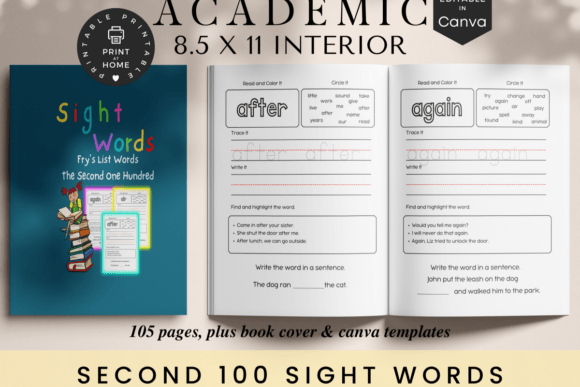
This isn’t about filling pages. It’s about giving kids repeated, multi-sensory exposure to high-frequency words they’ll see daily—in books, worksheets, signs, texts, even video game menus. The Second 100 Sight Words Workbook delivers that through four core actions on every page: trace, color, read aloud, and write independently. That rhythm builds muscle memory *and* recognition—not just spelling.
Where This Workbook Fits in Real Life
Think of it as a toolkit—not a curriculum. You don’t need lesson plans to use it. You just need a moment, a pencil, and a willingness to let repetition do its quiet work.
- For homeschooling parents: Tuck it into your weekly literacy rotation. Use one page during morning reading time, another after lunch as a calm-down activity. Because each word has its own dedicated page, you can go at your child’s pace—skip ahead when they’re confident, circle back when they hesitate on could or should.
- For tutors and learning specialists: Keep a printed copy in your bag—or pull up the Canva version on a tablet. When a student mixes up live and leave, or reads very as “vary,” you can instantly open the editable template, highlight the tricky letters, add a visual cue (like a tiny heart over the “e” in very), and print a custom version before the session ends.
- For teachers building intervention kits: Print only the words your small group is currently targeting—no need to bind full workbooks. Staple five pages into a mini-booklet, add a sticker chart on the back cover, and watch motivation rise alongside accuracy.
- For speech-language pathologists: These pages double as articulation practice tools. Say world slowly while tracing the “w-o-r-l-d” line. Color the “sh” in she with blue crayon while practicing the /ʃ/ sound. The structure supports both language and motor goals without extra prep.
Why Editable Canva Templates Change the Game
The Second 100 Sight Words Workbook includes 200 fully editable Canva templates—2 per word (one with section dividers, one clean list format). That means you’re not locked into a single design. You’re handed creative control.
Need larger tracing lines for a kindergartener with developing fine motor skills? Adjust the font size and line height in Canva in under 60 seconds. Working with an older struggling reader who finds coloring “babyish”? Swap out the clip art for subtle icons—like a lightbulb next to know, or a clock beside time. Teaching English learners? Add simple picture prompts above each word (cut + scissors icon, kind + heart icon) with zero design experience required.
You also get two book cover options—one ready-to-upload to KDP, one blank for full customization. Whether you’re publishing under your own brand, creating differentiated versions for different grade bands, or designing summer review packets for your school PTA, the cover adapts with you.
Practical Considerations Before You Begin
This workbook shines brightest when used intentionally—not as busywork, but as part of a broader literacy ecosystem. Here’s what helps it land well:
- Consistency over volume: One focused page, three times a week, beats rushing through ten pages once. Kids internalize sight words best when exposure is spaced and repeated—not crammed.
- Pair with authentic reading: After practicing only, every, and most, grab a leveled reader and hunt for those words together. That bridges the gap between drill and meaning.
- Watch for fatigue: Some kids resist tracing. That’s okay. Let them say the word aloud while you trace, then switch roles. Or use finger paint, magnetic letters, or sidewalk chalk outdoors for the same words. The Second 100 Sight Words Workbook gives you the words—the delivery method stays yours.
- Not a diagnostic tool: It won’t tell you *why* a child misreads does as “duz.” But it does give you clean, consistent practice space to reinforce the correct form once the pattern is understood.
Who Benefits Most—and How
The beauty of this resource is how differently it serves distinct users—without needing rewrites or redesigns.
A special educator might print black-and-white versions for students who get overwhelmed by color, then add colored borders in Canva only where visual cues support attention. A parent running a micro-school might combine two word lists into one themed booklet (“Words We See at the Park”: play, see, go, big) using the clean-list Canva templates. A content creator building a literacy subscription box could rebrand the cover, swap fonts to match their aesthetic, and include one custom-printed workbook per month—all from the same base files.
Even adult learners brushing up on foundational English benefit. The clean layout, clear letter formation guides, and lack of clutter reduce cognitive load—making it easier to focus on word shape and sound relationships without distraction.
What It Is—and What It Isn’t
The Second 100 Sight Words Workbook is a 105-page KDP-ready interior (8.5" x 11", bleed or no bleed) built for flexibility. It’s not flashcards. It’s not a teacher’s guide with scripted lessons. It doesn’t include assessments, answer keys, or phonics rules. And that’s intentional.
It’s a scaffold—not a script. A foundation—not a finish. You bring the relationship, the observation, the tweaks. It brings the structure, the research-aligned word list (Fry’s Second 100), and the editable access point so you’re never starting from zero.
When you open the Instruction Guide PDF, you’ll find direct links to every Canva template—organized, labeled, and ready. No hunting. No guessing. Just clarity, right where you need it.
Whether you’re uploading to KDP, printing for your third-grade intervention group, adapting for a bilingual classroom, or turning it into a digital journal with annotation tools—the Second 100 Sight Words Workbook meets you where you are. Not with bells and whistles, but with thoughtful, usable space for growth.