Mileage Log Book Vehicle KDP
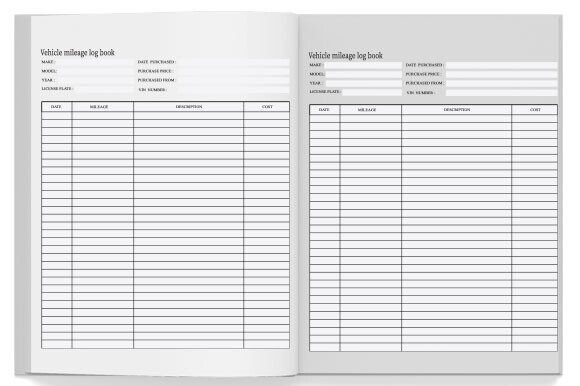
A Mileage Log Book Vehicle KDP is a pre-designed interior template intended for publishing as a physical or digital logbook on Amazon Kindle Direct Publishing (KDP). It is specifically formatted to meet KDP’s technical requirements—including trim size, color mode, resolution, and bleed—so creators can upload it directly without needing design expertise. This particular template features an 8.5×11 inch trim size, 100 interior pages, CMYK color support, and high-resolution assets (300 PPI) delivered in EPS, PDF, and PNG formats. It is tested and verified for compatibility with KDP’s print-on-demand system.
People considering this template are typically self-publishers, small business owners, freelancers, or independent contractors who need a compliant, ready-to-use mileage tracker for tax documentation, reimbursement claims, or fleet management. Unlike generic notebooks or spreadsheet-based solutions, a KDP-optimized log book offers consistency, professionalism, and reproducibility—especially useful for those planning to sell multiple copies or distribute branded versions to clients or employees.
Why Consider a Mileage Log Book Vehicle KDP Template?
There are several practical reasons someone might evaluate this type of template. First, IRS guidelines require accurate, contemporaneous records of business-related vehicle use—including date, destination, purpose, mileage, and odometer readings. A structured log book helps ensure compliance while reducing the risk of incomplete or inconsistent entries. Second, creating a print-ready interior from scratch demands familiarity with desktop publishing tools, color management, and KDP’s submission specifications. A pre-tested template eliminates that learning curve.
Third, users who plan to resell or license the log book benefit from having a professionally formatted interior that meets marketplace expectations. Buyers on Amazon often associate clean layout, consistent typography, and proper margins with reliability—factors that influence purchase decisions. Finally, because the template includes multiple file formats (EPS, PDF, PNG), users retain flexibility: PDF for direct upload, EPS for vector-based edits, and PNG for preview or marketing visuals.
Key Benefits and Realistic Expectations
The primary benefit is time savings. With a KDP-tested interior, users avoid troubleshooting common upload errors—such as incorrect bleed settings, RGB color profiles, or low-resolution images—that delay publishing. The 300 PPI resolution and CMYK color space ensure printed output matches expectations for grayscale or full-color interiors. The 100-page count provides sufficient space for quarterly or annual tracking without excessive bulk.
However, expectations should remain grounded. This is a template—not a finished product. Users must still add their own cover (designed separately), set pricing, configure distribution channels, and manage customer service. The interior does not include editable text layers in all formats; for example, PNG files are rasterized and not text-editable, while EPS may require vector software like Adobe Illustrator. Also, while the layout supports standard mileage logging, it does not automate calculations, sync with GPS, or integrate with accounting software—functions found in digital apps but outside the scope of a static print template.
Situations Where This Template Is a Strong Fit
This Mileage Log Book Vehicle KDP template suits users whose goals align with simplicity, scalability, and print fidelity. It works well for:
- Self-publishers launching a series of niche logbooks (e.g., medical visit logs, delivery logs, or equipment usage trackers) who want consistent formatting across titles;
- Accountants or tax professionals offering branded resources to clients as part of advisory services;
- Small fleet operators needing standardized paper logs for drivers without reliable smartphone access;
- Freelancers or gig workers who prefer analog recordkeeping and want a durable, portable tool that complies with IRS documentation standards.
In each case, the value lies in predictability: knowing the interior will print correctly, fit KDP’s workflow, and present professionally to end users.
When Alternatives May Be Worth Considering
Not every use case benefits equally from a static KDP template. Digital alternatives—like mobile apps (e.g., MileIQ, Hurdlr) or spreadsheet templates—offer real-time mileage capture, automatic categorization, export to CSV or PDF, and cloud backup. These are better suited for users prioritizing convenience, data analysis, or integration with tax preparation software.
Similarly, custom-designed interiors—built from scratch or via freelance designers—allow for unique branding elements, specialized fields (e.g., fuel cost tracking, driver signatures), or multilingual support. That level of customization matters if the user has specific compliance needs beyond basic IRS requirements (e.g., DOT regulations for commercial drivers).
Finally, users focused solely on personal use—not publishing or resale—may find free printable PDFs or built-in features in accounting platforms sufficient. Purchasing a KDP template makes sense only when there’s intent to publish, scale, or maintain control over the final printed artifact.
Practical Decision-Making Insights
To determine whether this Mileage Log Book Vehicle KDP template fits your needs, ask three questions:
- What is my primary goal? If you aim to publish and sell on Amazon—or produce physical copies for internal or client use—this template streamlines production. If you only need to track your own mileage, a digital tool or free printable may be more appropriate.
- Do I have the capacity to handle post-template tasks? You’ll still need to design a matching cover, write a compelling description, select keywords, and manage orders. Templates reduce design work, not operational work.
- How important is format fidelity? Because the template is KDP-tested and supplied in industry-standard formats, it minimizes trial-and-error during upload. That matters most if you’ve previously encountered rejection due to technical issues—or if you’re managing multiple KDP titles and value consistency.
Also consider long-term maintenance. While the template itself doesn’t expire, updates to KDP’s guidelines (e.g., changes to bleed requirements or supported file types) may eventually necessitate revisions. Users should verify current KDP specifications before uploading—even with a “tested” interior.
Lastly, note that the template’s origin—as noted in the source description—is tied to a broader catalog (e.g., Doctor Visit Logbook). That suggests the creator maintains a library of similarly structured logbooks. For users interested in multiple niches, reviewing the profile for related templates may offer efficiency gains across projects.