Daily Planner Organize Your Day 04
Daily Planner Organize Your Day 04 is a print-ready interior design file package intended for creators publishing physical planners through Amazon Kindle Direct Publishing (KDP). It includes high-resolution PDF and PNG files formatted to KDP’s specifications, designed for immediate upload and printing without further layout adjustments.
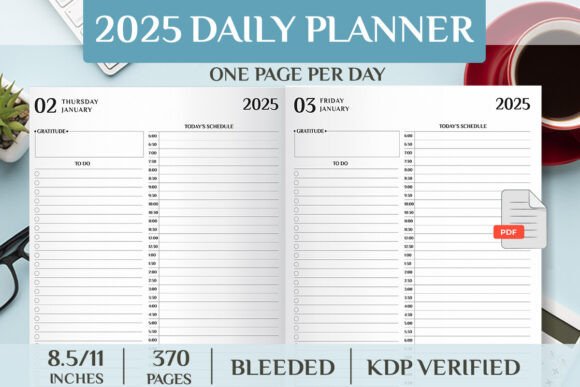
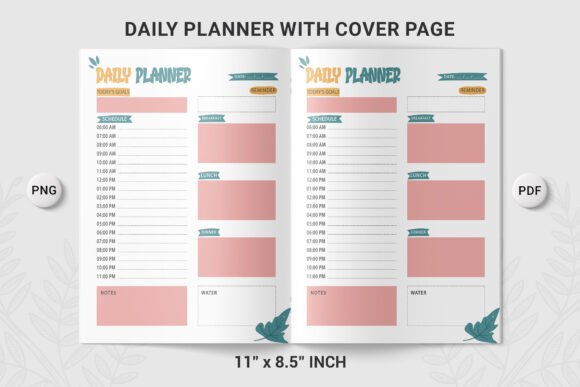
This resource is not a finished planner you purchase and use—it is a ready-to-publish interior template. The files are pre-sized to 11″ × 8.5″, include no bleed, and conform to standard KDP requirements for paperback interiors. Each page features a clean, functional daily layout optimized for time-blocking, task tracking, and reflection—consistent with the “organize your day” theme implied by the title.
People often seek resources like Daily Planner Organize Your Day 04 when they aim to launch or expand a planner-based product line efficiently. This may include independent stationery designers, small publishing teams, educators developing classroom tools, or content creators building branded productivity assets. The appeal lies in reducing the time and technical overhead associated with preparing print-optimized interiors—particularly for those unfamiliar with KDP’s formatting guidelines or professional design software.
One key benefit is consistency and compliance. The files are explicitly labeled as “100 Ready For Upload KDP,” meaning they meet core technical criteria: correct dimensions, 300 DPI resolution for PNGs, CMYK-safe color handling (implied by print-readiness), and absence of bleed—reducing the likelihood of rejection during KDP’s automated file checks. Users receive both PDF and PNG versions, offering flexibility: PDFs preserve vector elements and text scalability, while high-resolution PNGs support raster-based workflows or hybrid designs requiring layered transparency (e.g., watermarking or background textures).
However, this convenience comes with tradeoffs. Because the design is fixed and preformatted, customization options are limited. Users cannot easily adjust font families, spacing, or section hierarchy without reworking the files in graphic design software—potentially reintroducing compatibility risks. Likewise, the absence of bleed means any full-bleed background elements or edge-to-edge graphics will be trimmed during printing, limiting visual scope. Those seeking highly differentiated branding, accessibility enhancements (e.g., larger fonts or dyslexia-friendly type), or interactive elements (like perforated tear-away sections) will need to modify the files extensively—or consider alternatives.
Another consideration is audience alignment. Daily Planner Organize Your Day 04 assumes a default user preference for a traditional daily spread: likely one page per day, with space for time slots, priority tasks, notes, and possibly a brief reflection prompt. It does not appear to include weekly overviews, habit trackers, goal-setting pages, or monthly calendars—features commonly bundled in premium planner offerings. If your target readers expect integrated long-term planning tools, this interior alone would require supplementation with additional templates or companion products.
It is also worth noting that KDP’s interior requirements evolve. While the files are described as “print-ready” and “high-resolution,” users should still verify current KDP guidelines before uploading—especially regarding margins, minimum font sizes, and image embedding protocols. Relying solely on vendor-provided claims without independent validation may result in delays or revision requests.
Daily Planner Organize Your Day 04 is most suitable in specific contexts. First, for creators launching a low-cost, entry-level daily planner focused strictly on time management—not holistic life planning. Second, for those prioritizing speed-to-market over deep personalization, especially if they lack in-house design capacity. Third, for publishers testing demand for a particular layout style before investing in custom development. Its standardized format also supports consistent branding across multiple planner titles, provided the exterior cover and marketing copy reinforce a cohesive identity.
Conversely, alternatives may be preferable in other situations. If you plan to offer planners with specialized functionality—such as bilingual layouts, academic term calendars, project-based timelines, or ADHD-informed structures—you’ll likely need bespoke interiors built from scratch or adapted from more flexible source files (e.g., editable InDesign or Canva templates). Similarly, creators targeting niche markets—like students, remote workers, or caregivers—may find generic daily spreads insufficient without contextual adaptations (e.g., class schedule integration or shift-change notes). In such cases, working with a designer familiar with both user needs and KDP constraints often yields more effective outcomes than adapting a pre-made interior.
Practical decision-making starts with clarifying your goals. Ask yourself: Is my primary objective to publish quickly, or to differentiate through unique functionality? Do I have the technical ability to validate and adjust these files if needed—or will I rely entirely on their stated readiness? What complementary assets (covers, descriptions, keywords) will support discoverability once live? And critically: Does this interior match how my intended users actually structure their days?
For example, research into planner usage patterns shows many people prefer time-blocked formats with minimal visual clutter—but others rely heavily on weekly synopses or digital sync capabilities (e.g., QR codes linking to Notion templates). Daily Planner Organize Your Day 04 serves the former group well, but offers little out-of-the-box for the latter.
Finally, consider sustainability of use. A single-use interior limits scalability. If you intend to build a series—“Organize Your Day 05,” “Weekly Focus Edition,” etc.—evaluate whether this file set provides a reusable design system (consistent typography, grid logic, spacing rules) or exists as an isolated asset. Reusability affects long-term efficiency far more than initial download speed.
In summary, Daily Planner Organize Your Day 04 functions as a practical, technically sound starting point for KDP-based daily planner interiors—particularly for creators valuing speed, compliance, and simplicity. Its value lies not in novelty or depth, but in reliability and adherence to platform requirements. Whether it aligns with your needs depends less on its features in isolation, and more on how those features intersect with your publishing goals, audience expectations, and capacity for adaptation.