Weekly Planner 100 Pages: A Practical Tool for Intentional Weekly Planning
For professionals, educators, freelancers, and anyone managing overlapping responsibilities, weekly planning remains one of the most actionable ways to maintain clarity without overcomplicating structure. The Weekly Planner 100 Pages enters this space not as a novelty item but as a deliberately scaled, function-forward tool—designed for consistency over flash, usability over ornamentation. Its 100-page count isn’t arbitrary; it supports roughly 25 weeks of focused weekly review and forward planning—enough for a full semester, a project quarter, or a sustained habit-building cycle—without requiring constant replanning or page management.
What Sets This Weekly Planner Apart
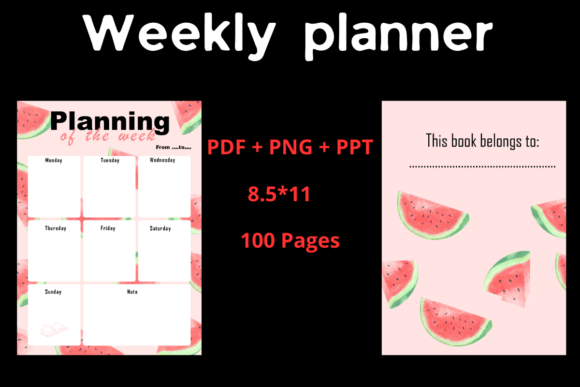
Unlike undated daily journals or overly minimal blank notebooks, the Weekly Planner 100 Pages uses a fixed weekly spread format: one clean, two-page layout per week. Each spread includes labeled columns for Monday through Sunday, with consistent spacing for tasks, appointments, notes, and priorities. There’s no visual clutter—no decorative borders, no competing fonts, no forced positivity quotes that distract from utility. Instead, the design prioritizes legibility, margin space for marginalia, and enough vertical room to list three to five meaningful items per day without crowding.
The planner also integrates lightweight reflection—not as an afterthought, but as part of its rhythm. Every fifth spread (roughly once every 2–3 weeks) includes a dedicated two-page section for goal review: short-term targets set earlier in the cycle, progress assessment, and brief notes on what supported or hindered momentum. This isn’t journaling for its own sake; it’s structured calibration—helpful for marketers tracking campaign timelines, educators aligning lesson plans with learning outcomes, or small business owners evaluating operational bottlenecks.
Usability in Real-World Workflows
In practice, the Weekly Planner 100 Pages performs well across varied routines. A freelance graphic designer used it for client project tracking: assigning deadlines to specific days, noting follow-up calls in margins, and using the reflection pages to assess time estimates versus actual hours spent. An elementary school teacher adapted it for classroom planning—mapping weekly literacy goals to days, logging student check-ins, and reserving bottom margins for quick observations about pacing or engagement shifts.
Its portable size (typically 6" x 9" or similar) fits reliably in laptop sleeves, tote bags, or backpack side pockets—unlike larger horizontal planners that require desk anchoring. The paper stock is generally 100–120 gsm, strike-balanced for smooth ink flow (tested with gel pens and fine liners) without bleed-through. It’s not archival-grade, but it holds up to moderate highlighter use and erasable pencil revisions—important for iterative thinkers who refine plans midweek.
Strengths Beyond Aesthetics
Three functional strengths stand out:
- Consistent scaffolding: Because each weekly spread follows the same layout, users build muscle memory—not just for where to write, but for how to scan, prioritize, and adjust. That predictability reduces cognitive load, especially during high-demand periods like product launches or exam weeks.
- Controlled scope: At 100 pages, it avoids the overwhelm of year-long planners while offering more continuity than single-month pads. Users report higher completion rates—fewer abandoned planners gathering dust—because the commitment feels finite and manageable.
- Neutral flexibility: There are no pre-filled dates, no rigid categories (e.g., “meal prep” or “fitness”), and no assumptions about your role or schedule. A blogger can track content calendars and pitch follow-ups; a physical therapist can log patient sessions and continuing education hours; a parent coordinating carpools and extracurriculars can allocate blocks without needing to overwrite or adapt templates.
Who Benefits Most—and When
The Weekly Planner 100 Pages suits people whose work or life rhythms operate on weekly cycles—not just calendar weeks, but natural cadences: content creators batching posts, consultants reviewing client deliverables, educators planning units, or caregivers aligning medical appointments and school schedules. It’s less ideal for those who need granular hourly scheduling (think surgeons or air traffic controllers) or long-horizon strategic planning (e.g., multi-year grant timelines), where monthly or quarterly views add more value.
It also works best when paired with a complementary system—not as a standalone command center, but as the tactical layer beneath broader frameworks. For example, someone using a digital task manager (like Todoist or ClickUp) might export recurring weekly priorities into the planner, then use handwritten notes for context, delegation cues, or quick ideation. Others pair it with a simple habit tracker or time audit sheet—keeping those tools separate maintains focus without diluting purpose.
Realistic Considerations
No planner solves for inconsistent habits—but the Weekly Planner 100 Pages lowers the barrier to entry. Its simplicity means less time spent customizing layouts and more time engaging with intent. That said, its effectiveness depends on regular, modest investment: 5–10 minutes at week’s end to reflect and 5 minutes at week’s start to outline. Skipping those steps doesn’t break the tool, but it does reduce its return on intentionality.
One limitation worth noting: because it’s undated, users must manually label weeks. That’s intentional—it supports flexibility (e.g., starting mid-month or aligning with fiscal quarters)—but requires slight discipline. Some users add a sticky note or light pencil mark for reference; others integrate week numbers directly into their top margin. It’s not a flaw—it’s a design trade-off favoring adaptability over automation.
Long-Term Value and Practical Fit
Over time, the Weekly Planner 100 Pages reveals patterns—not just in output, but in energy, attention, and decision fatigue. Reviewing past reflection pages helps identify recurring friction points: meetings scheduled too close together, underestimating prep time for presentations, or consistently deferring certain types of administrative work. That data isn’t flashy, but it’s actionable—especially for entrepreneurs refining operations or educators adjusting instructional pacing.
It’s also cost-effective relative to subscription-based digital alternatives that require ongoing access or platform dependency. One physical copy supports uninterrupted use offline, across devices, and without algorithmic nudges or notifications. For creators and knowledge workers increasingly sensitive to digital saturation, that analog reliability has measurable cognitive benefits—less context switching, fewer interruptions, more deliberate focus.
If your current planning feels either too fragmented (sticky notes, scattered apps, whiteboard photos) or too rigid (over-engineered spreadsheets, dated templates you’ve outgrown), the Weekly Planner 100 Pages offers middle-ground utility: grounded in structure, open to interpretation, and built to support real work—not just the appearance of productivity.