Editable Monthly Bill Tracker: Your Simple, Print-Ready Tool for Real-Life Financial Clarity
Let’s be honest—keeping track of bills doesn’t have to mean juggling sticky notes, missed due dates, or last-minute panic transfers. The Editable Monthly Bill Tracker is built for the real world: where rent is due on the 1st, the electric bill arrives mid-month, your gym membership auto-renews without warning, and you’re trying to save for a vacation *without* checking three different apps just to remember what’s coming up.
What It Actually Is (No Jargon, Just Usefulness)
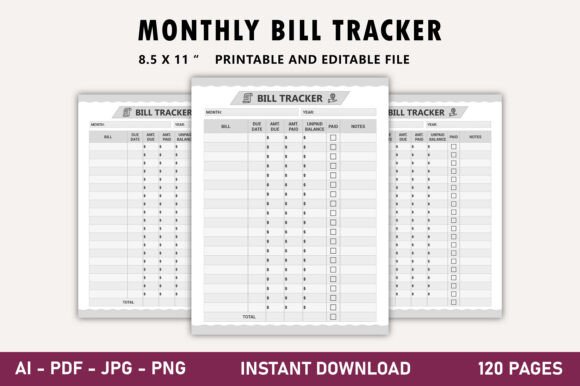
This isn’t software that needs updating or a subscription that expires. It’s a thoughtfully designed, print-ready low-content book template—120 pages of clean, functional space that helps you log, monitor, and reflect on your monthly expenses. You get two core formats: a ready-to-upload PDF with bleed (so nothing gets cut off at the edges when printed), and an editable Adobe Illustrator (.ai) file so you can tweak fonts, colors, or layout before publishing. Everything’s sized at 8.5″ x 11″, set at 300 DPI, and tested on Amazon KDP—meaning it prints crisply, binds smoothly, and looks professional on the shelf or in your hands.
Where It Fits Into Real Life (Not Just Theory)
Think about the small but meaningful moments where this tracker quietly makes a difference:
- For the new renter moving into their first apartment: No more forgetting to write down the water company’s contact info—or realizing too late that the internet bill is due *before* payday. With the Editable Monthly Bill Tracker, they can list every vendor, due date, amount, and payment method on one page per month—and even add notes like “Auto-pay enabled” or “Call to dispute $12.99 fee.”
- For the freelance designer or writer managing irregular income: Cash flow isn’t steady, but bills are. They use the tracker not just to record payments, but to forecast. By reviewing past months’ entries, they spot patterns—like how much goes to software subscriptions in Q1 vs. Q4—and adjust savings accordingly.
- For couples building shared financial habits: One partner handles utilities; the other manages insurance and subscriptions. Instead of texting reminders back and forth, they fill out the same physical tracker together each Sunday evening—turning finance into a quiet, collaborative ritual instead of a source of tension.
- For caregivers managing household bills for aging parents: When multiple accounts span different states and service providers, having one place to log account numbers, login URLs, and renewal dates reduces mental load significantly. The blank space beside each entry? That’s where they jot “Mom’s Medicare ID #”, “Dad’s pharmacy refill schedule”, or “Call to update address for Social Security statement.”
Why “Editable” Matters More Than You Might Think
“Editable” isn’t just a buzzword here—it’s flexibility with purpose. The Illustrator file lets you adapt the tracker *before* printing, not after. Need larger checkboxes for someone with low vision? Done. Want to add a column for “Payment Method (Cash/Credit/Zelle)” or “Notes on Late Fees”? Easy. Planning to brand it for your small business coaching clients? Swap in your logo, adjust the color scheme to match your website, and keep the structure intact. This isn’t about starting from scratch—it’s about tailoring a proven framework to fit *your* audience, *your* goals, or *your* workflow.
Who Gets the Most Out of It (Hint: It’s Not Just “People Who Like Paper”)
Yes, it appeals to paper lovers—but its real strength lies in serving people who value intentionality over automation. Consider:
- Students learning budgeting basics: A physical tracker slows things down just enough to build awareness. Writing “$47.50 — Spotify Premium” by hand creates a tiny pause—a moment to ask, “Do I still use this?” That pause doesn’t happen as easily in a scrolling app.
- Small business owners tracking personal + business expenses: They often mix categories early on. The Editable Monthly Bill Tracker gives them space to separate “Home Internet ($65)” from “Business Domain Renewal ($18)” on the same page—no need to toggle between tabs or export spreadsheets.
- Anyone recovering from financial overwhelm: When debt feels chaotic, simplicity is grounding. One sheet. Twelve months. Clear headers. No notifications. No algorithms suggesting “You spent 23% more on food this month!”—just facts, organized kindly.
Things to Keep in Mind Before You Use or Sell It
Like any tool, it works best when matched to realistic expectations:
- It’s not accounting software. You won’t generate tax reports or reconcile bank feeds. But it *does* help you catch discrepancies faster—if your tracker says $120 for car insurance but your statement shows $145, that mismatch becomes visible immediately.
- “Print-ready” means preparation matters. If you’re uploading to Amazon KDP, double-check your cover design aligns with the interior bleed (the .ai file includes guides). And if you’re customizing colors, confirm CMYK mode—not RGB—to avoid unexpected shifts in print.
- It supports consistency—not perfection. Missed a week? No problem. Flip to the next month’s page and start fresh. Its forgiving structure encourages continuation, not guilt.
Why This Stands Out in a Crowded Space
There are dozens of free bill-tracking templates online. What makes this one different is how it bridges digital convenience with analog intention. The editable AI file invites customization *without* technical friction. The bleed-enabled PDF removes guesswork for self-publishers. The 120-page count covers a full year *plus* room for notes, summaries, or goal-setting—no flipping between separate planners or scribbling on margins.
And because it’s been 100% tested on Amazon KDP, you’re not gambling on formatting errors or rejected uploads. That reliability matters—especially if you’re launching your first low-content book or expanding your catalog with tools people actually reach for, month after month.
A Small Tool With Quiet Momentum
You won’t see headlines about bill trackers—but you’ll feel their impact. In the relief of knowing exactly when the HVAC service contract renews. In the confidence of handing a clean, labeled copy to your accountant at tax time. In the habit of pausing once a month—not to fix everything, but to notice what’s working, what’s slipping, and what deserves your attention next.
The Editable Monthly Bill Tracker doesn’t promise financial transformation overnight. What it does offer is clarity, control, and continuity—one thoughtful page at a time.