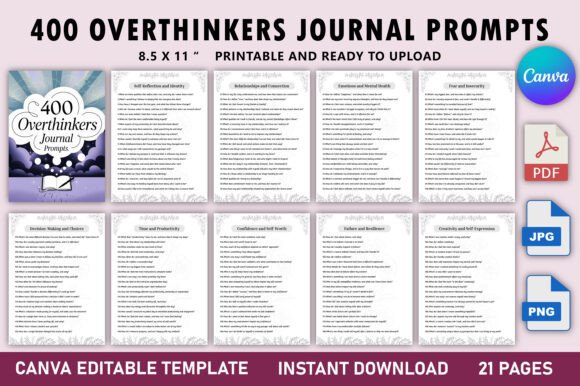
400 Overthinkers Journal Prompts
400 Overthinkers Journal Prompts is a structured journal resource designed to support intentional self-reflection for individuals who frequently engage in repetitive, circular, or emotionally charged thinking. It is not a clinical intervention or substitute for mental health care, but rather a practical tool intended to help users slow down thought patterns, identify recurring themes, and build greater awareness of internal narratives. The collection organizes prompts across 20 thematic categories—including emotions and mental health, fear and insecurity, boundaries and self-respect, and growth and change—offering breadth without assuming expertise or prior journaling experience.
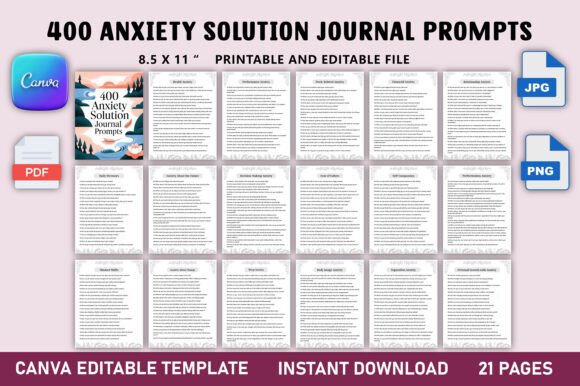
The companion digital version, 400 Overthinkers Journal Prompts Editable on Canva, provides the same prompt set in a customizable 8.5″ x 11″ format. With 21 pages and no bleed, it is optimized for use in Canva’s free or paid editor, allowing users to adjust fonts, colors, layout, or even reorder sections to suit personal preferences or accessibility needs. This flexibility supports varied learning styles, neurodivergent users, or those integrating journaling into broader habit systems (e.g., pairing prompts with morning routines or therapy homework).
People often seek resources like 400 Overthinkers Journal Prompts when they notice patterns such as difficulty making decisions, persistent self-criticism, rumination after social interactions, or exhaustion from managing internal dialogue. It may appeal to readers who value written reflection but struggle to generate meaningful questions independently—or who want consistency without the pressure of “starting from scratch.” Its thematic organization helps users navigate complex inner terrain without needing to diagnose or label their experiences first.
One benefit of this journal is its scope: 400 prompts distributed across nuanced domains offer sustained utility over time. Unlike single-topic journals, it allows shifting focus based on current needs—e.g., turning to “Healing and Forgiveness” during a period of grief, then later exploring “Creativity and Self-Expression” to reconnect with joy. The Canva-editable version adds utility for educators, coaches, or group facilitators who adapt materials for clients or workshops, or for users who prefer tactile journaling but also want digital backups or screen-reader compatibility through accessible Canva exports.
However, there are tradeoffs to consider. Because the prompts are text-based and open-ended, they require active engagement—not passive reading. Users expecting immediate insight or step-by-step guidance may find the format ambiguous without additional scaffolding (e.g., brief instructions on how to sit with discomfort, or when to pause and return to a prompt). Likewise, while the Canva file supports customization, it does not include pre-built templates, animations, or interactive elements—so users comfortable with basic Canva navigation will get more out of it than beginners unfamiliar with the platform.
Another consideration is alignment with goals. If someone seeks evidence-based cognitive tools—such as cognitive restructuring exercises grounded in CBT—or wants clinically validated interventions for anxiety or depression, 400 Overthinkers Journal Prompts serves best as a complementary practice, not a replacement for therapy or structured treatment programs. Similarly, readers prioritizing brevity may find the volume overwhelming; those preferring guided audio reflections or voice-to-text journaling may benefit more from apps with speech integration.
This journal is a strong fit for individuals who already journal occasionally but want deeper structure, or for those new to reflective writing who appreciate clear entry points. It suits people working through life transitions—career shifts, relationship changes, identity exploration—where naming thoughts feels more manageable than holding them silently. It also fits well alongside therapeutic work, offering material to bring into sessions or process between appointments. Because prompts avoid prescriptive language (“you should…”), they leave room for interpretation, which supports autonomy and reduces pressure to “get it right.”
Alternatives may be worth considering depending on specific needs. For example, someone focused on building emotional regulation skills might benefit more from a journal paired with psychoeducation—like one that explains grounding techniques alongside prompts. Readers seeking accountability or community interaction may prefer digital platforms with sharing features or peer feedback loops. Those with visual processing preferences could explore illustrated journals or art-based reflection tools instead of text-dominant formats. And if long-term habit formation is the goal, a minimalist journal with fewer prompts but built-in tracking (e.g., mood logs, weekly summaries) may better support consistency.
Practical decision-making starts with clarifying intent. Ask: What do I hope to understand or shift through journaling? If the answer relates to recognizing thought loops, identifying values in conflict, or gently challenging assumptions—400 Overthinkers Journal Prompts offers relevant pathways. If the goal is skill-building (e.g., reducing catastrophizing), pairing it with a workbook or therapist-led strategy may yield stronger outcomes. Consider also time availability: the Canva-editable version invites iterative use—customizing one section at a time—while the static version supports immediate, low-friction access.
Accessibility matters too. The Canva file allows font resizing, high-contrast adjustments, and screen-reader–friendly exports—useful for users with dyslexia, low vision, or ADHD-related focus challenges. However, it requires internet access and a Canva account (free tier sufficient), whereas printed versions don’t. Neither format includes audio narration or translation, so multilingual users or those with auditory processing preferences may need to supplement externally.
Finally, expectations shape experience. This journal does not promise reduced overthinking overnight. Its value emerges gradually—as patterns become visible, language becomes more precise, and pauses between stimulus and response widen. Progress may look like returning to a prompt weeks later and noticing subtle shifts in response, or choosing one theme per month rather than attempting all 400. Sustainability depends less on completion and more on attunement: using prompts as invitations, not obligations.
In summary, 400 Overthinkers Journal Prompts meets a specific need—structured, nonjudgmental space for examining habitual thought—with thoughtful design and adaptable delivery. Whether used as-is or customized via Canva, it functions best when matched to realistic goals, existing habits, and willingness to engage with ambiguity. For readers weighing options, clarity about purpose—and honest assessment of preferred formats and support needs—guides the most useful choice.