Why Memory Mastery Is the Next Competitive Advantage—And How the 50 Strategies to Strengthen Memory Ebook Fits Right In
In today’s hyperconnected, information-saturated world, attention is fragmented, deadlines multiply, and cognitive load grows daily. Professionals, creators, entrepreneurs, marketers, freelancers, and lifelong learners aren’t just competing on skill or speed—they’re competing on cognitive resilience. The ability to retain key insights, recall client preferences, synthesize cross-disciplinary ideas, and adapt learning in real time isn’t a “nice-to-have.” It’s foundational infrastructure for modern work.
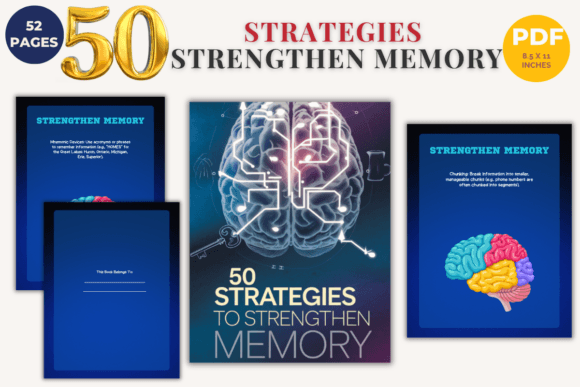
Enter the 50 Strategies to Strengthen Memory Ebook: not another abstract self-help manual, but a rigorously structured, practice-forward cognitive toolkit designed for people who don’t have time for theory without application. More than a static guide, it’s the backbone of the 50 Strategies to Strengthen Memory PDF journal—a living document built for iteration, reflection, and measurable growth.
A Response to Real-World Cognitive Friction
Consider the typical workflow of a marketing strategist reviewing campaign analytics, briefing designers, prepping stakeholder decks, and synthesizing customer feedback—all before noon. Or a freelance developer juggling three codebases, API documentation, and client-specific UX constraints. Or an entrepreneur toggling between financial modeling, pitch refinement, and team coaching. In each case, memory isn’t about rote recall—it’s about strategic retention: holding mental models long enough to connect, contrast, and create.
What’s changed isn’t human biology—it’s context. Tools like AI assistants and search engines reduce the need for memorization of facts, but they increase the demand for memory scaffolding: the ability to quickly anchor new knowledge to existing frameworks, retrieve nuanced patterns under pressure, and recombine ideas across domains. That’s where the 50 Strategies to Strengthen Memory Ebook shifts from “helpful” to indispensable.
Beyond Mnemonics: A Framework for Adaptive Cognition
The ebook doesn’t treat memory as a monolithic faculty. Instead, it maps 50 distinct, research-informed strategies across four functional dimensions:
- Encoding agility—how you initially process and structure information (e.g., dual-coding with imagery + verbal labels, chunking by semantic category);
- Retrieval fluency—how you access stored knowledge on demand (e.g., spaced retrieval prompts, self-quizzing templates, context-dependent recall drills);
- Consolidation rhythm—how you reinforce learning over time (e.g., micro-review windows, sleep-integrated reflection prompts, cross-day connection exercises);
- Metacognitive calibration—how you monitor and adjust your own memory performance (e.g., confidence-weighted recall logs, strategy-switching triggers, cognitive load check-ins).
This architecture reflects a broader shift in adult learning: away from one-size-fits-all pedagogy and toward personalized cognitive protocol design. Just as developers choose frameworks based on project scale and team expertise, professionals now curate memory practices aligned with their workflow rhythms, attention cycles, and output goals.
Why the PDF Journal Format Isn’t Just Convenient—It’s Intentional
The 50 Strategies to Strengthen Memory PDF journal leverages digital portability without sacrificing tactile intentionality. Unlike web-based tools that compete for attention with notifications and tabs, this journal is purpose-built for focused engagement—downloadable, offline-ready, and optimized for annotation across devices.
Its design responds directly to observed behavioral shifts:
- Modular consumption: Users rarely read cover-to-cover. Instead, they dip into targeted sections—e.g., “Strategy #27: Name-Association Mapping” before a networking event, or “Strategy #41: Scenario-Based Recall” before a client presentation.
- Progress visibility: Daily practice sections include timestamped reflection prompts (“What felt sticky today? What resisted recall?”) and lightweight tracking—not to gamify, but to surface patterns. Over time, users notice which strategies accelerate onboarding for new tools, deepen retention of industry reports, or improve spontaneous idea generation in meetings.
- Cross-platform continuity: Whether you’re sketching visual mnemonics on a tablet, typing reflections on a laptop, or printing a weekly spread for handwritten notes, the journal adapts—without requiring platform lock-in or subscription tiers.
This mirrors larger market movements: the rise of “tool-agnostic” productivity systems (like PARA or CODE), the resurgence of analog-digital hybrids (e.g., Rocketbook + Notion), and the quiet pivot from “app-first” to “intent-first” digital tools.
From Learning to Leverage: Practical Integration Across Roles
The power of the 50 Strategies to Strengthen Memory Ebook lies in its operational specificity. Here’s how it translates across professional contexts:
For Creators & Content Strategists
Remembering audience sentiment trends across quarterly reports, spotting narrative parallels between unrelated case studies, or recalling precise phrasing from past high-performing headlines—these aren’t incidental skills. They’re leverage points. Strategy #12 (“Emotion-Tagged Recall”) helps creators link emotional resonance to specific messaging structures; Strategy #33 (“Cross-Modal Anchoring”) supports remembering tone, pacing, and visual rhythm simultaneously—critical when repurposing long-form content across platforms.
For Entrepreneurs & Founders
Early-stage founders wear dozens of hats—and must hold contradictory data points in mind: unit economics vs. brand equity trade-offs, hiring timelines vs. runway constraints, investor expectations vs. team capacity. Strategy #19 (“Constraint-Based Chunking”) teaches how to group variables by decision domain rather than chronology, reducing working memory overload. Strategy #46 (“Future-State Visualization Loops”) builds mental rehearsal for high-stakes scenarios—funding conversations, crisis comms, scaling dilemmas—so responses feel grounded, not reactive.
For Marketers & Growth Practitioners
Marketing moves fast—but insight compounds slowly. The ability to recall how a channel algorithm update impacted engagement six months ago—or how a competitor’s messaging shift preceded a pricing change—separates tactical operators from strategic analysts. Strategy #8 (“Temporal Layering”) guides users to tag memories with temporal metadata (e.g., “Q3 2023 iOS update → +12% push opt-ins”), turning anecdote into analyzable signal. Strategy #29 (“Pattern Interrupt Drills”) trains rapid contextual switching—essential when pivoting between campaign analysis, creative briefs, and cross-functional alignment.
Not Just for “Improvement”—But for Sustainable Cognitive Longevity
There’s growing recognition that cognitive vitality isn’t reserved for students or retirees—it’s a career-spanning asset. Neuroplasticity research confirms that targeted, consistent practice reshapes neural efficiency well into later decades. But “practice” only sticks when it’s embedded—not as an extra task, but as a natural extension of existing habits.
The 50 Strategies to Strengthen Memory PDF journal embeds seamlessly: a 5-minute morning review before checking email, a 3-minute recall drill during a commute, a 10-minute weekly synthesis session alongside calendar planning. Its structure respects professional time budgets while delivering compounding returns—because every time you successfully retrieve a concept, you strengthen the pathway for next time.
Looking Ahead: Memory as Infrastructure, Not Afterthought
As AI handles more routine cognition—drafting, summarizing, translating—the human edge sharpens around judgment, synthesis, and contextual wisdom. These depend less on storing data and more on curating mental models, recognizing subtle discontinuities, and drawing unexpected connections. That’s advanced memory work—and it’s trainable.
The 50 Strategies to Strengthen Memory Ebook meets this moment not with hype, but with humility: no claims of “unlocking hidden brain power,” just 50 field-tested, adaptable, human-centered techniques—each paired with immediate application. It assumes you’re already capable. It simply gives you better levers.
In a landscape crowded with quick fixes and vague promises, this is something rarer: a precision instrument for the mind—one that grows more valuable the more deliberately you use it.