Monkey Coloring and Craft Sheets: Creative Fuel for Makers, Educators, and DIY Enthusiasts
Monkey Coloring and Craft Sheets aren’t just another set of black-and-white outlines—they’re versatile, print-ready assets designed to slot seamlessly into real creative workflows. Whether you're laser-cutting custom nursery décor, assembling themed classroom resources, or building a KDP coloring book from scratch, these sheets deliver precision, consistency, and playful charm without the design overhead.
What Exactly Are Monkey Coloring and Craft Sheets?
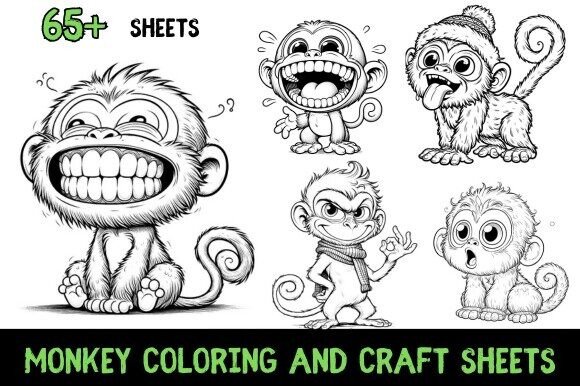
At their core, Monkey Coloring and Craft Sheets are high-resolution, vector-informed printable files—67 unique monkey-themed designs, each optimized for multiple applications. They arrive in a single ZIP file containing PDF (CMYK, print-ready), JPG (300 DPI), and PNG (transparent background) formats—all sized for A4 and US letter (8.5×11″). The lines are clean, intentional, and thick enough for confident coloring by kids yet refined enough for precise laser cutting or vinyl plotting.
Where These Sheets Actually Shine in Real Life
It’s not about *what* they are—it’s where they show up and solve problems. Here’s how different people use them—without reinventing the wheel:
- DIY Laser Cutters & Makers: Need a quick, scalable jungle-themed element for a baby shower banner, wooden wall art, or acrylic keychain? These monkey silhouettes cut cleanly on Glowforge, Ortur, or xTool machines—no tracing, no digitizing, no trial-and-error alignment. One user shared how she batch-cut 42 monkey shapes from birch plywood in under 9 minutes, then painted and strung them as a mobile for her toddler’s room.
- Teachers & Homeschoolers: Instead of spending hours searching for age-appropriate primate visuals, educators pull a monkey sheet for labeling anatomy (tail, prehensile grip, opposable thumbs), sequencing life cycles, or pairing with nonfiction reading. Bonus: the bold outlines hold up well when photocopied or projected onto whiteboards—and many students naturally start adding patterns, textures, or habitat details during free-draw time.
- KDP & Self-Publishing Creators: Building a “Jungle Friends” coloring book? These sheets eliminate licensing risks and design bottlenecks. You can mix and match monkeys with other animal sets, add your own titles and instructions, and format directly for Amazon’s KDP specs—no need to hire an illustrator for consistent line weight and spacing.
- Small-Batch Gift Makers: Think hand-stamped cards, fabric transfer prints, or pressed-flower bookmarks with monkey cutouts. Because the PNGs include transparent backgrounds, they drop easily into Canva or Adobe Express for mockups—and the 300 DPI resolution ensures crisp results even when scaled down to 2 inches tall.
- Therapists & Activity Coordinators: Occupational therapists report that the moderate complexity of some monkey poses (e.g., one holding a banana, another swinging mid-air) supports fine motor development better than overly simple or chaotic designs. And because the pages are black-and-white—not cartoonish or overly stylized—they feel inclusive and calming for neurodivergent teens and adults exploring sensory-friendly creative routines.
Practical Things to Keep in Mind Before You Print or Cut
These sheets work beautifully—but like any tool, they perform best when matched to your setup and goals:
- Laser cutting success starts with file prep: While the PDFs are CMYK-optimized for printing, most laser software prefers vector-based SVG or DXF. If your machine doesn’t accept PDF paths natively, open the PDF in Inkscape (free) and export as SVG—then trace and simplify if needed. The clean linework means minimal cleanup.
- Coloring experience varies by paper: For crayons or colored pencils, standard 24 lb copy paper works fine. But for markers or gel pens, go heavier—32 lb cardstock or marker paper prevents bleed-through and gives richer saturation.
- Age adaptability isn’t automatic—it’s adjustable: Younger kids may find detailed monkey faces overwhelming at first. Try printing at 125% scale to enlarge features—or select only the 12 simplest outlines (like sitting or sleeping poses) for early learners. Adults often prefer the more intricate versions with foliage, textured fur, or geometric patterns embedded in the design.
- KDP formatting needs double-checking: Even though the PDFs are print-ready, Amazon requires specific margins (0.25″ minimum) and bleed settings. Always upload a test PDF to KDP’s previewer before publishing—especially if combining these monkey sheets with your own covers or interior text.
Why This Set Stands Out Among Other Animal-Themed Printables
Not all monkey-themed downloads offer the same flexibility. What makes this collection especially practical is its intentional balance: it avoids oversimplification (which limits adult engagement) and excessive clutter (which frustrates laser users or young colorists). There’s no watermarked preview layer, no forced upsell pages, and no missing file types—you get what’s promised, instantly.
The variety matters too: among the 67 pages, you’ll find monkeys in motion (swinging, leaping, climbing), at rest (curled, seated, peeking), and interacting (holding fruit, cradling babies, perched on branches). That range means you’re not stuck repeating the same pose across projects—it supports storytelling, visual sequencing, and thematic cohesion.
A Few Quiet Limitations—Worth Noting Upfront
These sheets excel at what they’re built for—but they’re not magic wands. They don’t include editable text layers (so adding custom names or quotes requires external software). They’re also not animated, layered PSD files—so if you need multi-stage reveal effects or color separation for screen printing, you’d need to build those out separately. And while the designs are culturally neutral in style, they don’t depict specific monkey species with scientific accuracy—so they’re better suited for expressive craft than biology curriculum supplements.
Real Projects, Real Results—No Design Degree Required
You don’t need to be a graphic designer to turn these into something meaningful. A parent turned three monkey outlines into reusable felt board characters for storytime. A woodworker used one side-profile monkey as a template for carving a spoon handle. A church volunteer printed 20 copies, laminated them, and used dry-erase markers for a Sunday school “jungle safari” matching game. None required special software—just access to a printer, basic scissors or a laser cutter, and the willingness to let the design do some of the heavy lifting.
That’s the quiet power of Monkey Coloring and Craft Sheets: they meet you where you are—with your tools, your timeline, and your reason for making—and give you a solid, joyful starting point.